The Hub
Made for LoveThe Hub is Byron’s domestic compound: a vast, clinical residence embedded in the technological empire he founded. To Hazel, it never becomes a home in the ordinary sense. Its systems register and analyze its occupants, its remoteness narrows contact with the outside world, and its apparent conveniences become instruments through which Byron can monitor and manage her. The Hub’s defining contradiction is that it promises comfort and safety while making private life feel impossible.
Setting and Access
The Hub belongs to a larger landscape of Gogol’s operations. Byron’s most important ancillary buildings and a microcity for the company’s worker elite are also situated far from ordinary urban life. Most regular employees work in city branches, but Byron distrusts cities and limits his trips away from the compound. He is only a few minutes from the central office during the day and returns home to sleep at around ten each night, with the regularity Hazel associates with a programmed machine. The compound’s isolation is therefore not simply a matter of distance: it reflects Byron’s suspicion of the world beyond the systems he controls.
Entry and movement inside The Hub depend on layered recognition technology. The entrance uses voice and retinal detection; certain rooms additionally require a fingerprint and keypad code, while the cars are operated remotely. Hazel contrasts those controls with the physical key to her father’s house, whose teeth press into her palm when she grips it too tightly. The small, tangible key represents the manual life she hopes to reclaim after leaving Byron. Against it, The Hub’s invisible permissions make access conditional on systems that belong to Byron’s technological world.
The scale and design of the compound reinforce this separation. It is sprawling, sleek, spotless, and clinical, with touch and recognition technology embedded throughout its walls. On Hazel’s first visit, an escort leads her through a ten-minute labyrinthine route to a mood-lit room where Byron sits in a suspended black chair. He works on what appears to be a glass device while another glass-like screen occupies his attention. The room’s unusual bowl, filled with small white stones above blue flames, further marks the space as a designed environment rather than a familiar domestic interior. Hazel arrives having expected an evening together; instead, the elaborate setting places her inside a world whose rules and purposes she does not control.
A Residence That Does Not Feel Like Home
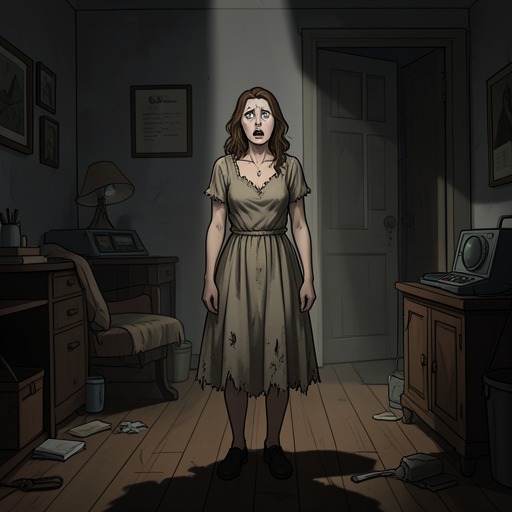
Hazel’s first encounters with The Hub establish her uncertainty about what living there means. Its scale impresses her, but the building does not seem real to her, and familiarity never changes that response. She develops a habit of walking through it with her eyes wide open, as if the house remains something to inspect rather than inhabit. In her private conception, it resembles a holding place for the dead, a replica of somewhere souls might go after leaving the world. That image gives the compound a distinctly suspended quality: pristine and elaborate, yet detached from ordinary life.
The marriage makes the distinction between residence and home more consequential. Hazel hardly ever leaves The Hub, while Byron spends most of his days at the nearby central office and returns on a highly regular schedule. The compound thus contains much of their shared domestic life but does not offer Hazel an independent sphere within it. Even the home’s apparent abundance cannot overcome the isolation. When she later describes her marriage to Herbert, she recalls becoming afraid to bring objects into the house and finding that purchases delivered there lost their interest. She had imagined spending extravagantly before leaving Byron, even ordering absurd quantities of soup, but fear and the urgency of escape displaced that plan. The Hub’s remoteness helps make departure feel not just emotionally difficult but practically dangerous.
Surveillance and the Marriage
The Hub’s recognition systems extend far beyond doors and room access. Hazel remembers the sensors and monitoring growing claustrophobic early in the marriage. Byron initially reassures her that the surveillance is harmless, but he begins commenting on her activities while away from the compound. Meals supplied by staff change in response to reports from bodily scans she did not know were being taken. What presents itself as attentive care is also a process of collecting and using information about her.
Byron eventually admits that cameras, scanners, and related equipment cover every room, including the bathroom, and that no moment of Hazel’s time inside The Hub has gone unrecorded. He describes the system as necessary for safety, convenience, health, and technological research. He also claims that processing Hazel’s words and actions can reveal her state of mind with almost ninety-seven percent accuracy. Hazel experiences these explanations as a violation of bodily and mental privacy: sex itself seems redundant to her when sensors have already placed her body under continuous observation. The compound’s domestic architecture has become an extension of Byron’s access to her.
That surveillance also supports a larger commercial ambition. Byron tells Hazel that a proprietary brain technology inside her is calibrated to her physiology and represents years of company research. He fears that the asset might be lost or discovered by competitors, and he wants her to cooperate in a real-time stream of information from her brain to his. He further explains that presenting the technology as an intimate extension of their long marriage could make a public rollout more persuasive than introducing it through a new relationship. The Hub therefore connects private control to corporate value: Hazel’s marriage, body, and public identity are all treated as resources that can advance Gogol’s plans.
The Hub After Hazel Leaves
After Hazel leaves, the compound remains present in her life through Byron’s attempts to reach and influence her. She doubts his claims and suspects that reports about Herbert could be used to draw her back. His offer of support is entangled with monitoring: he knows about her shoulder and poor nutrition, offers physical therapy and supplements, and continues to frame information as something he can use to direct her choices. Hazel’s unease shows that leaving the building does not immediately end the reach of the systems associated with it.
Her later fears give the house an almost portable quality. While staying with Herbert, she keeps a bedroom window open despite feeling exposed and repeatedly looks outside, afraid that Byron might somehow have transferred the entire house into a warehouse chamber at The Hub. She recognizes the fear as illogical, yet the compound’s history of recording and interpreting her life has made the distinction between physical distance and mental security difficult to trust. The view of palm trees in the yard offers a modest reassurance that she is still outside its walls.
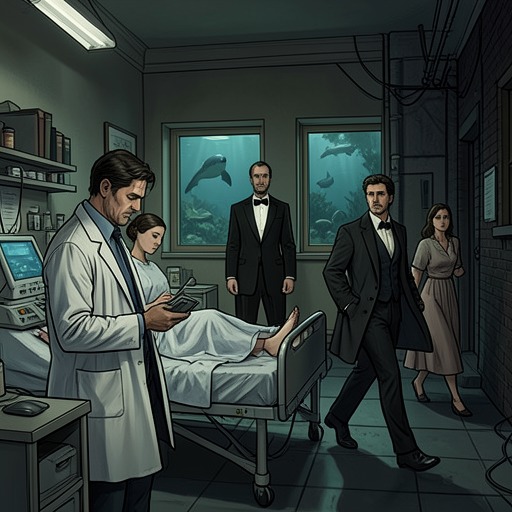
The Hub’s surveillance also becomes visible to others through leaked footage from its bedroom security cameras. The video shows Byron and Fiffany in bed wearing sleep helmets before Byron sits upright in distress; Fiffany removes her helmet and tries to understand what is wrong. Hazel insists that the reported malfunction cannot explain what she sees and concludes that Fiffany acted intentionally, though the footage itself does not establish what caused Byron’s death. The disclosure that the cameras recorded the bedroom, despite Byron having told Hazel they shut off at night, confirms the persistence of surveillance even in a space presented as private.
Narrative Significance
The Hub makes technological control architectural. Its remote location, recognition-based entry, automated monitoring, and clinical surfaces combine to turn an apparently advanced home into a system for managing access, information, and dependence. For Byron, the compound is an environment organized around risk reduction and technological ambition. For Hazel, its sensors transform domestic intimacy into exposure, while its remoteness makes escape feel precarious. The contrast with her father’s physical house key clarifies what she wants to recover: not simply a different residence, but a life less mediated by Byron’s devices and decisions.
The compound also gives the novel a concrete setting for the conflict between intimacy and surveillance. Byron treats the information gathered inside The Hub as protection, research, and commercial property; Hazel experiences the same systems as the erasure of privacy and choice. Its rooms can be spotless and its devices useful, but neither cleanliness nor convenience makes the house hospitable. The Hub’s decisive significance lies in that mismatch: it is built to make life legible and controllable, yet the more completely it records Hazel, the less it can function as a home.